The Australian higher education landscape has undergone a seismic shift. As of early 2026, the digital learning market in Australia is projected to reach a staggering $15.5 billion, with a compound annual growth rate exceeding 26%. What was once a temporary pivot during the pandemic has now become a permanent, sophisticated pillar of the Australian Qualifications Framework (AQF).
For students at major institutions like the University of Sydney, Monash, or UWA, “going to class” now involves a sophisticated blend of AI-driven platforms, synchronous webinars, and virtual collaboration tools. However, navigating this high-tech terrain requires more than just a stable NBN connection—it demands a strategic approach to academic management.
The Evolution of the Digital Campus in Australia
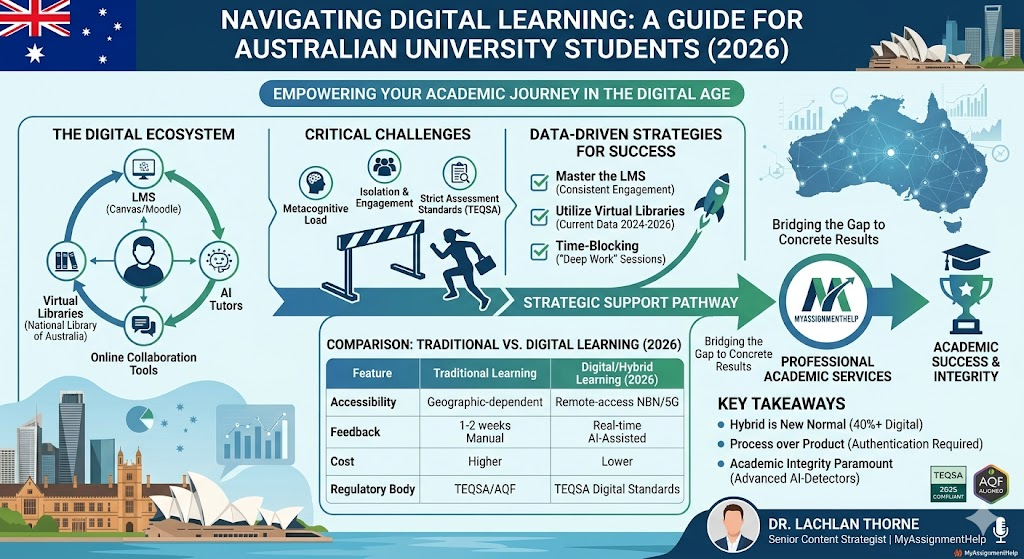
Digital learning in 2026 is no longer just about recorded lectures. Under the 2026 TEQSA (Tertiary Education Quality and Standards Agency) updates, universities are now mandated to provide “equivalent learning experiences” across both physical and digital modes. This has led to the rise of Adaptive Learning Pathways, where AI tutors provide real-time feedback on student progress.
Managing these complex digital requirements can be overwhelming for many. This is why seeking professional assignment help in Australia has become a common strategy for students to bridge the gap between abstract online modules and concrete academic success. By leveraging expert insights, students can better understand the specific marking rubrics and localized academic standards required by Australian professors.
Local Case Study: UNSW’s 2026 “Digital Integrity First” Policy
A prime example of this shifting landscape is the University of New South Wales (UNSW). In early 2026, UNSW implemented the Integrated Digital Assessment Framework. This policy moved away from traditional high-stakes exams in favor of “authentic digital assessments” that mirror real-world workplace tasks.
Under this mandate, students are evaluated on their ability to use digital tools—including data analytics and collaborative software—to solve industry-specific problems. However, the rubrics have become significantly more rigorous regarding “process documentation.” Students must now prove the evolution of their research. Utilizing specialized assessment help Australia ensures that your work meets these “Next-Gen” standards while maintaining 100% academic integrity and proper documentation.
Data-Driven Strategies for Digital Success
To excel in a digital-first environment, Australian students should adopt these evidence-based strategies:
- Master the LMS: Platforms like Canvas and Moodle are now integrated with “Early Warning Systems” (EWS). Consistent engagement is often a hidden metric in participation marks.
- Utilize Virtual Libraries: Access the National Library of Australia’s digital archives. Sources from 2024–2026 provide the most current data for Nursing, Law, and Engineering papers.
- Time-Blocking: Research from the Productivity Commission (2026) shows that students who use “Deep Work” sessions of 90 minutes for online assessments see a 30% increase in retention.
Comparison: Traditional vs. Digital Learning in Australia (2026)
| Feature | Traditional Learning | Digital/Hybrid Learning (2026) |
| Accessibility | Geographic-dependent | Remote-access (NBN/5G enabled) |
| Feedback | 1-2 weeks (Manual) | Real-time (AI-Assisted + Human) |
| Cost | Higher (Travel/Housing) | Lower (Digital-only options) |
| Regulatory Body | TEQSA / AQF | TEQSA Digital Standards |
Key Takeaways
- Hybrid is the New Normal: Expect at least 40% of your course delivery to be digital.
- Process over Product: Policies at universities like UNSW now require proof of how you reached your conclusion, not just the final answer.
- Academic Integrity: With advanced AI-detectors in use, always ensure your support services prioritize original research and localized referencing.
Frequently Asked Questions (FAQs)
Q: Are online degrees from Australian universities viewed differently by employers in 2026?
A: No. As of 2026, major employers in cities like Sydney and Melbourne prioritize digital literacy. A degree obtained through digital or hybrid means is seen as proof of self-discipline and technical proficiency.
Q: How can I ensure my online assessment meets Australian standards?
A: Focus on specific referencing styles like APA 7th or AGLC4. Utilizing professional assessment help Australia can provide an “academic audit” to ensure your work meets the TEQSA 2026 guidelines.
Q: What is the biggest risk of digital learning for Australian students?
A: The primary risk is “digital disengagement.” Without physical campus presence, it is easy to fall behind. Successful students combat this by setting strict digital timetables.
About the Author
Dr. Lachlan Thorne is a Senior Content Strategist at MyAssignmentHelp, specializing in the intersection of educational technology and the Australian tertiary sector. With deep expertise in the TEQSA 2026 regulatory framework, he provides students with data-driven strategies to navigate the Australian Qualifications Framework (AQF). Based in Australia, Dr. Thorne is dedicated to fostering academic excellence through localized research, ethical support, and high-integrity content solutions designed for the modern digital student.
References
- OpenPR (2026). Australia Online Education Market Projected to Reach USD 15.5 Billion by 2034.
- Productivity Commission (2026). Report on Government Services: School and Tertiary Education.
- OECD (2026). Digital Education Outlook: AI and the Future of Learning.
- TEQSA (2026). Higher Education Good Practice Hub: Teaching and Learning.